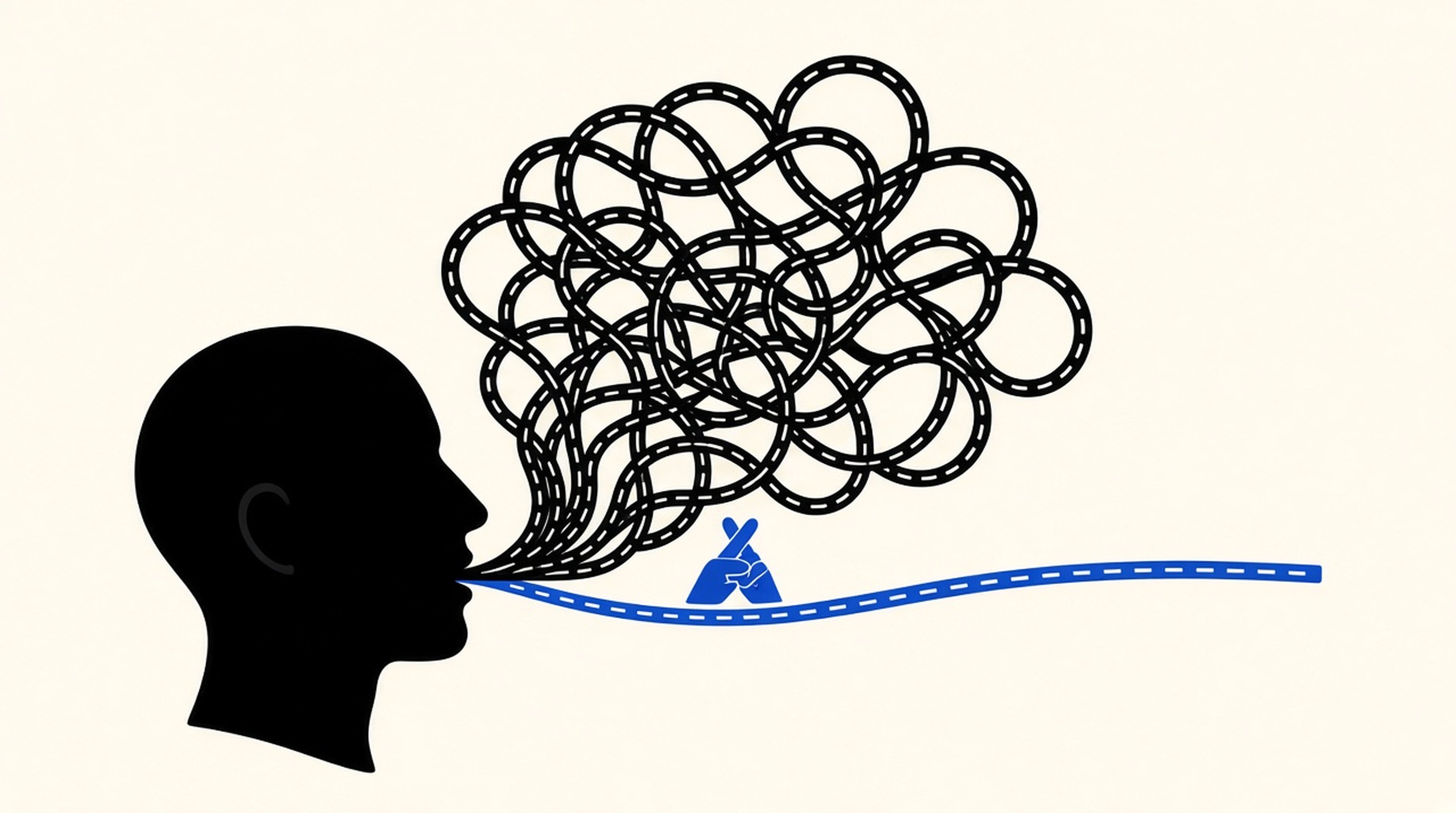
Someone across the table is telling a story that fits a little too well.
The timeline lines up. The details are neat. The voice is calm. No awkward laugh. No sudden interest in the floor tiles. If this were a movie, the camera would already be circling them, waiting for the tell.
You watch their eyes anyway.
Because somewhere between school corridors, crime dramas, and that uncle who swears he “just knows,” you absorbed a quiet rule: liars leak. Perfect liars don’t.
Which raises a stranger question than “Is this person lying?”
What would it actually take to lie perfectly?
Not charmingly. Not well enough. Perfectly — as in: consistent under pressure, emotionally seamless, socially tuned, and invisible to the kind of scrutiny humans think they are good at.
Imagine a perfect liar machine
Imagine you could build one. Not a scammer. A machine.
It would need at least four modules.
First, memory: every invented detail stored, indexed, and ready for the follow-up question you forgot was coming. Where were you. Who else was there. What colour was the bag. What did you order. What did they order.
Second, emotion: a dial that can suppress guilt, fear, delight, boredom — whatever the moment requires — without freezing the face into that weird “I am being natural” mask.
Third, theory of mind: a live model of what the other person already knows, what they are likely to check, what would sound suspiciously polished, and what would sound boring enough to be believed.
Fourth, cognitive spare capacity: enough leftover attention to keep speaking while also monitoring your own story, their face, the room, and the version of yourself you are performing.
That is the thought experiment. Now notice what it assumes.
It assumes a perfect lie is mainly a performance problem — like acting, but with higher stakes and worse rehearsal time.
A lot of research suggests that framing is incomplete.

What intuition gets wrong
Intuition treats lying like theatre and detection like spotting bad acting.
Look away? Lying.
Fidget? Lying.
Too still? Also somehow lying.
Across 75 countries and 43 languages, the Global Deception Research Team found a dominant pan-cultural stereotype: liars avert their gaze.[4] People really do believe the eyes are the leak.
But belief is not evidence.
In a large meta-analysis of behavioural cues, DePaulo and colleagues combined more than a thousand estimates across 158 possible tells. Many behaviours showed no clear link to deceit, or only weak ones. Liars were, on average, a bit less forthcoming, a bit less compelling, a bit more tense or negative — not cartoonishly shifty.[3] Gaze aversion, the world’s favourite tell, sits near the bottom of usefulness in that literature; later summaries put its average effect close to zero.[3][4]
So the first crack in “perfect lying” is this: most people are trying to hide from cues that do not reliably exist.
Which means a huge amount of amateur deception energy is spent managing folklore.

Lying is often extra work
Here is the scientific hinge.
Truth-telling can be hard — especially when the truth is awkward, emotional, or socially expensive. But in many controlled settings, adding deception adds operations: suppress the true answer, construct or select an alternative, keep it consistent with known facts, and manage how it lands.
A 2017 meta-analysis of 114 computerised reaction-time studies found a large average slowdown for lying versus truth-telling, even after correction for publication bias.[5] Lying took time. The effect was messy across paradigms, and it shrank when people were instructed to avoid detection — which is already a hint that “perfect” liars are partly people fighting their own latency.
Interview researchers such as Aldert Vrij have pushed a related idea: if lying burns more cognitive fuel, then adding load — reverse-order recall, unexpected questions, secondary tasks — can widen the gap between liars and truth-tellers.[6][7]
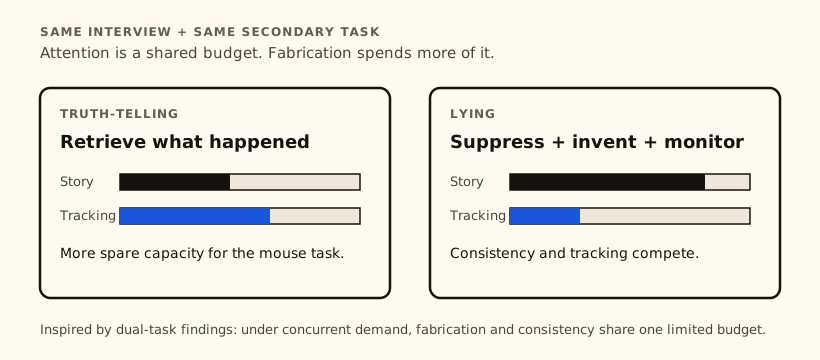
A dual-task study made that tradeoff unusually concrete. Participants answered interview questions while tracking a randomly moving dot with a mouse. A frequency measure of how continuously they could adjust their tracking dropped more during lying than truth-telling, and more during first-time encoding than later retrieval. Their verbal consistency was also lower for lies — and worse still when the tracking task was running.[8]
Read that carefully.
It is not “science proves you cannot lie.”
It is closer to: under concurrent demand, fabrication and consistency compete for the same limited budget.
That is what “perfect” would have to defeat.

The social cheat code: people start on your side
Now the part intuition almost never includes.
You do not only need to perform the lie. You need to survive a listener. And listeners are not continuous lie scanners.
Timothy Levine’s truth-default theory argues that honesty is the starting place of human communication. People generally tell the truth unless they have a reason not to, and people generally accept messages as honest unless something triggers suspicion.[9][10] In everyday talk, the thought “wait — is this false?” often does not even boot up.
That sounds naive until you notice what communication would become without it.
If every sentence required active verification, conversation would feel like airport security. Slow. Expensive. Exhausting. The truth-default is less a moral virtue than cognitive infrastructure.

This also helps explain a famous laboratory number.
Across hundreds of studies, people asked to judge lies and truths in real time, without special aids, average about 54% accuracy — correctly calling truths more often than lies.[1] A 2025 reanalysis argues that this headline figure is easy to misread: it is tangled up with truth bias, the veracity effect, and experimental setups that often force 50/50 lie–truth base rates that do not match ordinary life.[2]
So if your definition of a perfect lie is “nobody ever notices,” reality offers an uncomfortable shortcut:
Many imperfect lies succeed because nobody was hunting.
That is not mastery. That is the default.
Perfect lying is a myth of infinite bandwidth.
What the evidence actually shows
Put the pieces together and “perfect lying” starts looking less like a ninja skill and more like a stack of simultaneous constraints.
Constraint 1 — Content consistency. A lie is not one sentence. It is a branching tree of future questions. Dual-task work suggests consistency is one of the first things to wobble when attention is split.[8]
Constraint 2 — Cognitive load. In reaction-time and many interview paradigms, deception carries an average cost.[5][6] Novel, bald-faced fabrication seems especially expensive. The more your story has to be invented from scratch, the more the machine needs spare RAM.
Constraint 3 — Cue folklore. People monitor the wrong dashboard. Gaze, fidgeting, “looking nervous” — culturally sticky, weakly diagnostic on average.[3][4] A liar trying to look “honest” by starring in a documentary about eye contact is solving the wrong puzzle.
Constraint 4 — Listener psychology. Detection improves more when people seek diagnostic information and context than when they stare harder at cheeks and blink rate.[9][10] Perfect performance against cue-watching is partly theatre for an audience using a broken instrument.
Constraint 5 — Motivation backfire. DePaulo’s cue review found that cues can become more visible when people are highly motivated to succeed, especially when identity is on the line.[3] Wanting the lie to be perfect can itself make the performance noisier.

So the honest thesis is not “lying is impossible.”
People lie. Often. Sometimes casually. Sometimes skilfully.
The honest thesis is: perfect lying is a myth of infinite bandwidth.
What usually works is not perfection. It is efficiency — staying close enough to truth, rehearsing the expensive parts, avoiding needless invention, and surfing the fact that most listeners are not in interrogation mode.
Where the tidy story breaks
If the article stopped here, it would oversell cognitive load as destiny.
It is not.
Information Manipulation Theory 2 (IMT2) argues that deceptive discourse is often incremental problem-solving, not a pre-planned alternative universe. On that view, lying is not intrinsically always harder than honesty. People frequently stay close to available truth, edit mid-utterance, and choose the communicative path of least resistance.[11][12] Commentaries on IMT2 explicitly challenge the idea that deception must be more load-inducing by nature.
There is also evidence that practice can shrink the cost of lying in some laboratory tasks.[13] A repeated lie is not the same mental object as a fresh one. Hu and colleagues themselves note exceptions for repeated lies, and their dual-task findings are clearest for bald-faced, low-consequence fabrications in a specific sample.[8]
And the big accuracy meta-analyses are mostly about certain kinds of judgments under certain base rates.[1][2] Life is not a DVD of strangers answering trivia while strangers vote “lie” or “truth.”
So the competing interpretation matters:
Sometimes the “perfect” move is not maximal acting.
It is minimal invention.
That is still not perfection. It is strategy under constraint.
What this is actually about
Strip away the crime-show lighting and the question becomes almost philosophical.
Why do we want perfect lies to exist?
Maybe because a perfect liar would prove something flattering about control: that a human mind can fully author social reality, edit the self in real time, and leave no residue.
But minds are not clean editors. They are predictive, leaky, resource-limited systems running conversation on a trust protocol that assumes most packets are fine.
A perfect lie would require you to outrun your own memory limits, your own emotional leftovers, your model of another mind, and the listener’s occasional decision to stop defaulting to belief — all at once.
That is less like talent and more like trying to edit a document while the document is also editing you.
Return to the question
So: how do you lie perfectly?
By the standards of folklore — calm eyes, locked story, zero tells — you mostly don’t. The tells people hunt are weak, and the work of fabrication is real enough that dual demands expose the budget.[3][5][8]
By the standards of social life — getting an imperfect falsehood accepted — you often “succeed” without perfection, because listeners begin in truth-default and only sometimes switch modes.[9][10]
By the standards of cognitive science, the closest thing to a perfect lie is probably not a masterpiece of performance. It is a small edit that stays near the truth, costs less to maintain, and never wakes the trigger that turns a conversation into an audit.[11]
Which means the title was a trap.
The useful skill was never learning to lie perfectly.
It was noticing that “perfect” was the wrong engineering target for a brain that runs on tradeoffs.
Maybe the most honest sentence in the whole literature is also the least cinematic:
A perfect lie would need more working memory than most moments are willing to lend you.
And if that sounds unsatisfying, good.
Satisfaction is what a too-perfect story tries to sell.