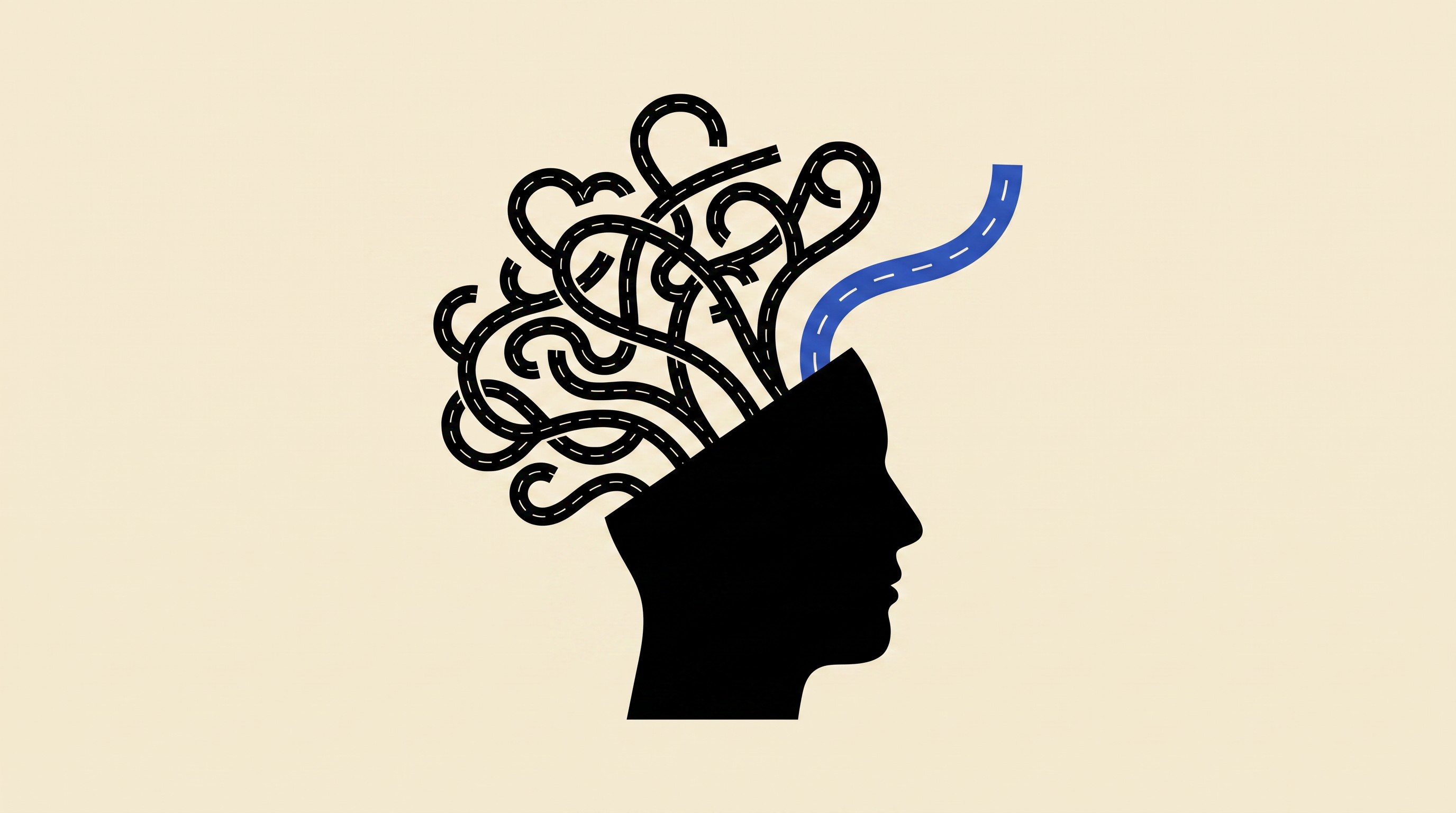
Imagine you are standing at a bus stop. The bus is late by six minutes. Most people are annoyed, then they open Instagram, then the bus comes.
You, meanwhile, have accidentally created a small simulation studio inside your skull. Maybe the driver took another route. Maybe there was an accident. Maybe this bus system has been designed by someone who has never waited for a bus. Maybe you should have walked. Maybe every decision you have made since 2017 has been a minor variation of this bus stop.
That is funny until it is not.
People often turn this experience into a flattering little myth: smart people suffer because they see too much. It is a good sentence. It is also suspiciously convenient. It lets intelligence become a glamorous explanation for anxiety, loneliness, sadness, insomnia, awkwardness, and the unread email from three weeks ago.
The research says something more interesting, and thankfully less cinematic. High cognitive ability is not a curse. It does not reliably predict higher anxiety or depression. A 2024 systematic review and meta-analysis found no significant overall increase in either among gifted groups, although results varied substantially across studies and definitions.[2]
The problem is not seeing more. It is never leaving the control room.
A capable mind can generate alternatives quickly. That is useful. It helps you notice patterns, catch contradictions, imagine consequences, and ask the irritating question that everyone else has politely stepped around.
But there is a tiny design problem here. A brain that can build ten possible futures may also keep all ten windows open. Not because it is superior. Because it has not been told which windows matter.
Intelligence gives you more possible routes. It does not automatically give you a map legend.
That distinction matters because repetitive thinking is not one thing. In a longitudinal study of 751 young adults, reflective pondering, the attempt to understand thoughts and feelings, was positively associated with several intelligence measures after depressive symptoms were accounted for. Brooding, the heavier loop of dwelling on negative feeling, was not associated with intelligence in the same way.[1]
Basically: thinking deeply and being trapped in thinking are not identical twins. They are more like cousins who become unbearable when they stay too long at the same family function.

Why ordinary uncertainty can feel so loud
Suppose someone replies to your message with “okay.” That word can mean agreement, annoyance, distraction, exhaustion, a typo, or that they have put their phone down because their tea is boiling over. A person who notices only one explanation may be wrong. A person who notices eight explanations may be tired.
This is not proof that analytical ability causes suffering. It is a thought experiment about bandwidth. More models can be useful when there is a decision to make. They become exhausting when your nervous system treats every incomplete signal as a problem that needs a meeting.
And life is full of incomplete signals. People are unclear. Work is ambiguous. The future is rude enough not to send a preview. The old promise that “if I think hard enough, I can make uncertainty behave” has never really worked. It just gives uncertainty a larger office.
Social mismatch is not a hierarchy
There is another reason this topic gets messy. If you often think in abstractions, or arrive at the third implication of something while the conversation is still on the first, you may sometimes feel out of sync with a room. That is a difference in pace, context, interest, or communication style. It is not a license to decide that everyone else is shallow and you have been sent here as a cursed prophet with a LinkedIn account.
The available research on gifted adults points in the same direction: outcomes are heterogeneous. In a 2025 exploratory study of 219 Canadian adults identified as intellectually gifted, factors such as lower socioeconomic status and twice-exceptionality were linked with higher risk, while relationship status and perceived potential achievement were associated with better well-being.[3] In other words, context keeps showing up and ruining the simple story.
Which is good news. If intelligence alone caused a hard life, there would be very little to do about it except become a houseplant. If environment, support, health, money, belonging, and habits matter, then there are handles.
Reflection needs an exit door
Reflection asks: What happened? What can I learn? What next? It has a job and, ideally, an end time.
Brooding asks: Why am I like this? What if this says everything about me? Can we replay the same evidence but with worse lighting? It feels productive because it uses the same vocabulary as analysis. But it is not necessarily moving anywhere.
Eg: You make a mistake in a presentation. Reflection might identify one slide to revise and one awkward moment to laugh about later. Brooding turns the event into a full archaeological dig of every embarrassing thing you have done since school assembly. Same brain. Entirely different travel plan.

So, is life harder if you are intelligent?
Maybe some parts of it can be. A mind that notices patterns can notice the bad ones early. A mind that can imagine consequences can feel consequences before they exist. A mind that values clarity can get unusually irritated by vague people, vague jobs, vague relationships, and the phrase “let’s circle back.”
But none of that means intelligence condemns you to a difficult life. The better question is whether your thinking is serving your life or replacing it.
Research in older adults also finds cognition, mental health, social engagement, education, and demographic conditions tangled together rather than moving in one clean direction.[4] That study cannot tell a younger reader what their intelligence is doing to them. It does make the larger point: people are systems, not one-variable explanations.
Maybe intelligence is not the ability to have the final answer. Maybe it is noticing when you have built a very impressive machine for avoiding the next ordinary step.
The bus will still arrive. The question is whether you can get on before your brain writes a white paper about the timetable.