Imagine closing your eyes, flying for a bit, meeting someone who died years ago, and accepting the whole absurd theatre with total conviction. Then you wake up and your brain shrugs: random noise. Actually… maybe that shrug is the least believable part.
The evolutionary scandal of sleep
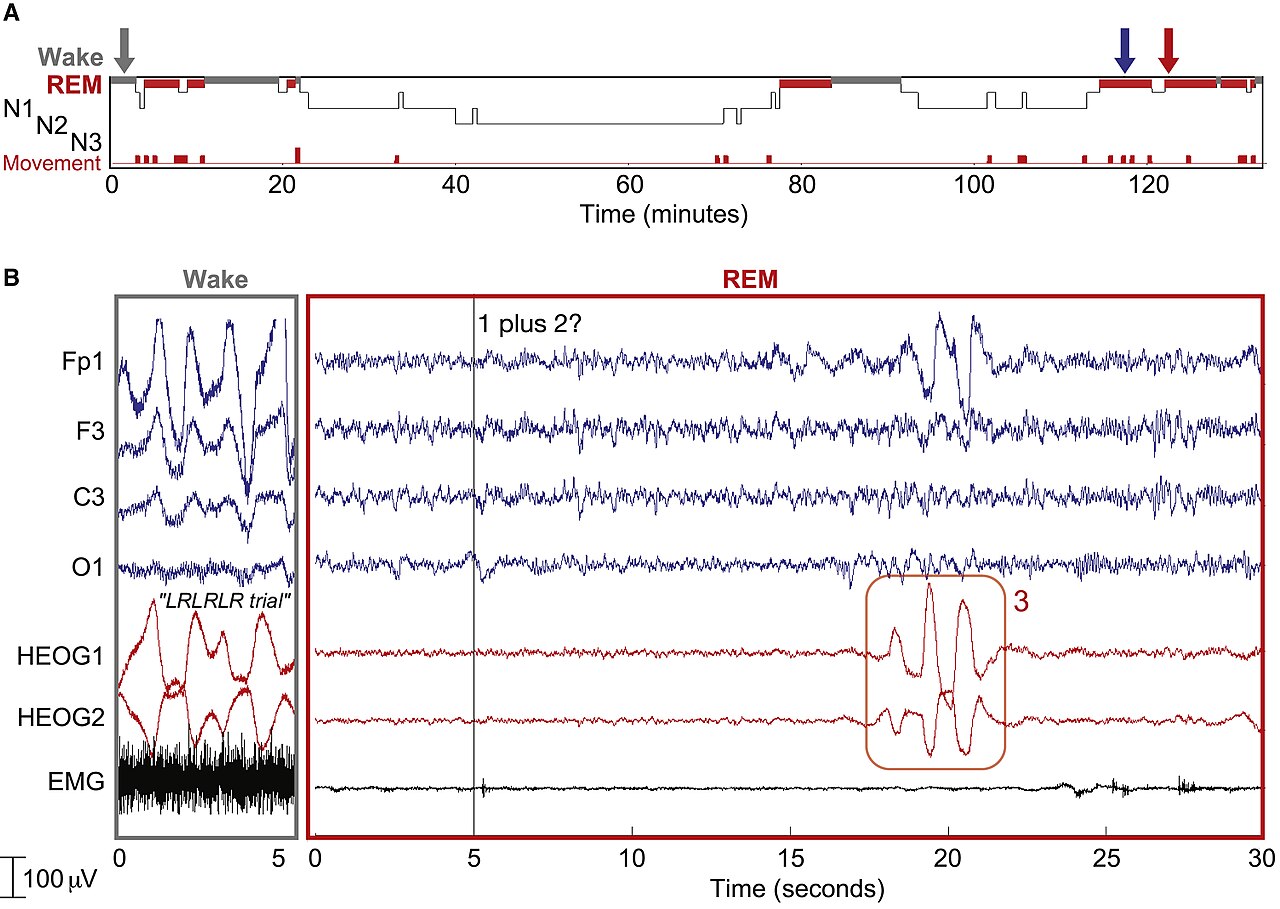
From a pure survival view, sleep is rude. For hours you are immobile, undefended, and useless against predators. Then evolution adds REM sleep: brain activity roaring near waking levels, eyes darting, body chemically paralysed [1]. Why pay that metabolic tax just so we can forget our pants in an airport?
For a long time, popular culture treated dreams like coded letters from a Freudian basement. Modern sleep science has mostly swapped the decoder ring for EEGs and scanners. What shows up is both stranger and more ordinary: dreams look like a biological simulation engine.

Threat simulation — one strong story
One compelling framework is Antti Revonsuo’s Threat Simulation Theory [2]. The idea: REM dreams are a kind of ancestral virtual reality. Offline, the brain rehearses chase, fall, freeze, fail-to-run — updating threat circuitry without risking the actual body.

Of course science rarely keeps one neat box. Another line of work points to synaptic homeostasis: overnight pruning of less useful daytime connections so tomorrow has room to learn [3]. In that reading, dreams might be the subjective flicker of a network reorganising itself. Less movie night. More server maintenance with weird lighting.
You are simultaneously the author, the audience, and the stage of a play you did not consciously schedule.
What happens when the simulator hiccups
We get clues when dreaming is disrupted — by drugs, lesions, or sleep disorders. People who lose dream imagery sometimes report subtler problems with emotion regulation or creative problem-solving, though the causal pathways are still debated [4]. Soften that sentence in your head: association, not a clean “dreams = creativity” law.
Separately, targeted memory reactivation during sleep has been linked with better next-day problem solving in some experiments [5]. Your brain is not only resting. It is quietly re-filing the day’s mess while you look unconscious.
Back to the pillow
So the next time you wake from a plot involving a talking badger and an airport you have not visited in a decade, maybe skip the dream dictionary. You may just be watching old hardware do what it has done for a very long time: run the simulation, poke the edges of intuition, and keep the waking mind from becoming too brittle.
You spend a third of your life in the dark so the other two-thirds have a chance of making sense. Sleep well — the rehearsal is unpaid, but apparently non-negotiable.